
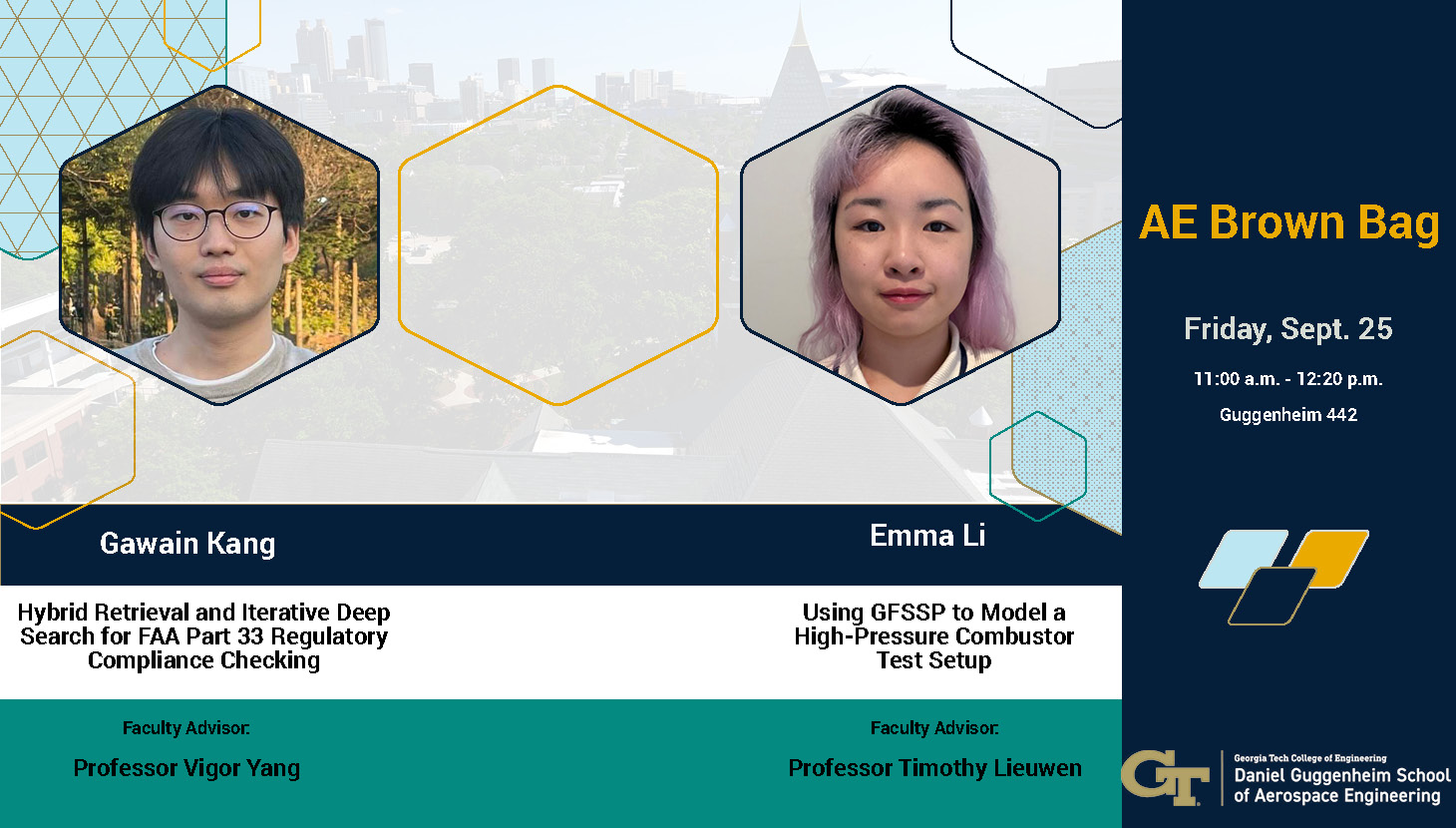
AE Brown Bag Seminars
featuring
Gawain Kang
Emma Li
Friday, September 25
11:00 a.m. - 12:20 p.m.
Guggenheim 442
Pizza Served
Gawain Kang
Title:
Hybrid Retrieval and Iterative Deep Search for FAA Part 33 Regulatory Compliance Checking
Abstract:
Aerospace regulations are long, dense, and written in precise legal and technical language, so engineers, pilots, and technicians often spend a lot of time searching for the one clause that applies to their situation. This project builds a retrieval-augmented compliance-checking assistant, starting with FAA 14 CFR Part 33 (Airworthiness Standards: Aircraft Engines). The system splits the regulation into searchable chunks and retrieves them two ways: BM25 keyword search, which catches the exact regulatory terms, and FAISS vector search over text embeddings, which catches meaning when the wording differs. Reciprocal Rank Fusion (RRF) merges the two rankings into a single candidate list. An iterative deep search loop then takes over. A language model reviews the candidates, keeps only the chunks that help answer the question, and decides whether the evidence is sufficient. If it is not, the model writes a refined query and searches again. When enough evidence has been gathered, the selected chunks are passed to the model to generate an answer grounded in the regulation text. The language models run locally through Ollama, so the assistant can work offline and keep confidential engineering data on the user's own machine. This talk presents the system architecture, how the RRF and retrieval parameters were tuned for regulatory text, and a demonstration of the prototype. It also covers the next step: letting users enter engine parameters and receive a map of the Part 33 requirements they meet or fail. The tool is meant to be a fast early check that supports human review, not a replacement for it.
Faculty Advisor:
Professor Vigor Yang
Emma Li
Title:
Abstract:
With the high temperatures and flow rates in a high-pressure combustor, using water to film-cool was necessary to ensure the test equipment survived multiple long-duration tests. Using GFSSP (Generalized Fluid System Simulation Program), a network flow model was created to analyze the wall temperature of the test equipment at different mass flows for both the combustor and the water cooling the combustor. The results for no water for cooling, at fractions of the maximum flow rate, and at maximum capacity were analyzed, showing the necessity for and minimum water flow rate required for film cooling at steady state to remain under a safe operating temperature. The usage of GFSSP simplified and created an easy iterative process to analyze the test setup. It is a great tool for analyzing any fluid network or flow paths, including heat transfer analysis, with applications extending to other experiments at the Combustion Lab and simulating large-scale fluid networks used in rocket propulsion and ground systems.
Faculty Advisor:
Professor Timothy Charles Lieuwen